Electric Construction Equipment in 2026: What's Out There? And What Are Some Practical Uses?
Key takeaways
- Electric construction equipment is here — but still niche, making up roughly 1% of U.S. earthmoving sales.
- The sweet spot: urban, indoor, and noise-sensitive jobsites where emissions and sound matter most.
- Runtime, charging access, and application fit remain the biggest barriers to adoption.
- Compact equipment leads electrification thanks to intermittent duty cycles and lower energy demands.
- OEMs are expanding electric lineups — from mini excavators to mid-size wheel loaders.
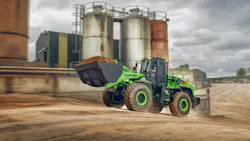
You can run electric construction equipment right now. Battery-powered off-highway machinery has been arriving over the last few years, and more than ever before, there are some extremely cool e-machines in the earthmoving, compressor, and MEWP markets. It's exciting. But also, electric is still super niche. Unit sales are still small. It's expensive (purchase price at least). Aerial lifts have the most acceptance, but in the earthmoving sector in America, electric makes up about 1 percent of units sold (maybe less). It's niche, but it’s not standing still.
Electric equipment keeps getting better. And for progressive contractors, there are real opportunities to use it in the right applications. More work is happening around urban spaces and zero-emissions zones. Indoor work is obviously a no-brainer. More projects sit near people — neighborhoods, schools, hospitals, and city centers. These are places where noise and emissions matter. Those pressures aren’t going away.
The big thing is: Electric equipment demands more planning. Charging access. Runtime. Application fit. If those pieces don’t line up, diesel can remain the smarter choice. That's why we're here to help. It’s about knowing where it works — and using it to your advantage when it does. We’ll start that journey with some expert advice from OEM product managers. They break down where electric makes sense, how to manage batteries, and what to evaluate before buying. Then we move into the machines themselves — a lineup of new electric equipment hitting the market today. Are you ready to charge?
Why electric compact equipment fits the new rules of the jobsite

This section was written by Lee Tice, senior product manager at JCB North America.
The rules of the jobsite have changed. Emissions matter. Noise matters. Access matters. Electric compact equipment is positioned to meet those demands without changing how crews work. Most compact machines are not operating at maximum load for an entire shift. They dig, reposition, wait, load out, and move to the next task. That intermittent duty cycle aligns naturally with modern lithium-ion battery systems engineered around real-world usage patterns rather than theoretical extremes. Instead of oversizing batteries for rare peak demand, manufacturers are designing machines around how compact equipment is actually used in the field.
Project locations are evolving as well. More work is happening in dense urban corridors, inside existing buildings and adjacent to occupied structures. Zero emissions at the point of use eliminate the need for additional ventilation systems in enclosed spaces. Lower sound levels reduce disruption in residential areas and around schools, hospitals, and commercial centers. In many cases, that can expand allowable work windows where permitted and help contractors maintain tighter schedules.
Charging infrastructure has also matured. Compact electric machines are designed to recharge overnight using common 110- or 230-volt power supplies, with fast-charge options available when turnaround time is critical. That mirrors how many compact units are already staged between shifts, minimizing operational disruption. Maintenance considerations further support adoption. With no engine oil, no fuel filters, and no exhaust aftertreatment systems, electric compact machines reduce service complexity and eliminate several consumable costs. As specifications tighten and communities demand cleaner, quieter construction practices, electric compact equipment is not simply an alternative power source. It is a practical response to the way modern jobsites are built and managed today.
Lithium-ion batteries: practical guidance for safe handling and performance
This section was written by Dominik Damm, director of product management of booms at Genie
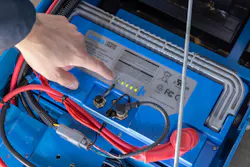
Lithium-ion batteries are becoming a standard power source in modern MEWPs, offering strong performance, quieter operation, reduced emissions, and lower total cost of ownership. As adoption increases, fleet owners and operators are focused on practical questions around storage, transportation, and recycling. With the right approach, lithium batteries are straightforward to manage and built for long, low-service lives.
Smart Storage Practices: Store batteries clean, dry, upright (unless otherwise specified), and out of direct sunlight. Ideal storage temperatures are below 95°F, as prolonged heat can shorten battery life. Batteries should also be stored separately from other hazardous materials. For equipment in storage, operating mode matters. Genie recommends Sleep mode for short-term storage and OFF/SHIP mode for periods longer than 24 hours — Genie has a switch or digital controls that enable these modes. For storage beyond six months, maintain batteries between 50 to 80 percent state of charge and check at least twice a year to preserve long-term health.
Transportation and Damage Response: Lithium-powered MEWPs can be transported much like other machines, but operators should understand applicable lithium battery transport regulations, such as those outlined by USDOT PHMSA. Lithium-ion batteries should be protected in their own self-contained packaging. There are numerous certifications; your MEWP manufacturer can share additional details about what they are certified or compliant to. Genie maintains its lithium-ion batteries to UL 1973. While damage is rare, any battery suspected of impact-related damage should be isolated immediately. Do not handle it further — contact the manufacturer and keep the area clear until proper guidance is received.
Planning for Recycling: End-of-life batteries require certified lithium recyclers. Most facilities request basic information such as dimensions, weight, MSDS documentation, and part identification — details manufacturers typically provide at purchase. Lithium technology delivers measurable benefits. With proper handling, today’s lithium-powered MEWPs can perform well into a machine’s second life, protecting both safety and long-term fleet value.
What to consider when evaluating battery-powered excavators

This section was written by Tim Cicora, product manager for excavators at Takeuchi-US
Battery-powered excavators are gaining traction in construction, particularly in compact size classes where current battery technology can meet performance demands. Their smaller size and lower energy requirements make them practical candidates for electrification, especially in tight or urban jobsites and indoor applications. For contractors, the primary advantages are reduced maintenance and improved jobsite conditions. Electric machines have fewer moving parts and eliminate engine-related service items such as oil changes and fuel system maintenance. They also operate with zero on-site emissions and significantly lower noise levels, making them well-suited for use near homes, schools and hospitals — or even indoors.
However, electric equipment isn’t a one-size-fits-all solution. Buyers should closely evaluate runtime, charging requirements, and available infrastructure. Many models offer approximately four to eight hours of operation depending on the application, and while fast charging options can reduce downtime, access to adequate power on the jobsite remains a key consideration.
Upfront costs for electric excavators are typically higher than comparable diesel models, but lower maintenance and operating expenses can offset that over time. Ultimately, the decision comes down to application fit. Electric excavators excel in environments where emissions, noise or ventilation are concerns, while traditional diesel machines may still be the better choice for remote or high-demand jobsites.
Tips for selecting electric micro scissors

This section was written by Mirco Negri, senior product manager of specialty equipment at JLG.
Electrification is rapidly reshaping the access equipment market, and micro-sized scissor lifts are emerging as a natural fit for this shift. As environmental regulations tighten and jobsites place greater emphasis on sustainability, contractors and rental companies are prioritizing equipment that reduces emissions, noise and overall environmental impact. Electric-powered micro lifts directly address these demands, offering zero-emission operation that makes them suitable for indoor environments and mixed-use spaces where air quality and noise control are critical.
This trend is especially evident in facilities such as hospitals, data centers, airports and commercial buildings, where traditional engine-driven equipment is often impractical or prohibited. Electric micro-sized lifts provide a solution by enabling safe, efficient work at height without disrupting operations or requiring extensive ventilation. Their quiet performance also allows work to be completed during normal operating hours, improving productivity and reducing downtime.
Beyond environmental benefits, electrification aligns with evolving expectations around efficiency and cost of ownership. Electric systems typically require less maintenance than internal combustion engines and offer longer duty cycles with improved battery technology. This translates to more uptime and lower operating costs for rental fleets and end users.
Micro-sized scissor lifts amplify these advantages by combining electric power with compact, lightweight designs. Their ability to operate in confined, sensitive environments while delivering reliable performance makes them a practical solution for modern job sites. As electrification continues to accelerate across the industry, these machines represent a key intersection of sustainability, functionality and versatility, positioning them as an increasingly essential tool for both contractors and rental providers.
Top electric construction equipment in 2026
The next section shifts from strategy to machines. We highlight the latest electric equipment across compact and mid-size categories. These product announcements show where performance, runtime, and charging have improved — and where the technology stands today.
Volvo L120 Electric wheel loader
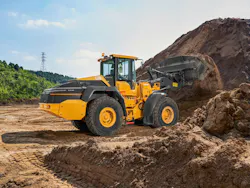
Volvo CE has scaled its electric equipment leadership into the mid-size class with the L120 Electric wheel loader. This 22-ton loader delivers a 6.6-ton payload, matching the performance of its diesel equivalent but with zero emissions, near-silent operation and 30 percent lower maintenance costs. Its 228-kilowatt battery provides five to nine hours of runtime depending on the application. When it’s time to “fuel up,” use a 180-kilowatt DC fast charger to go from 10 to 95 percent in about 90 minutes, or use a portable charging unit or plug into the grid overnight. The L120 Electric wheel loader excels in applications like urban infrastructure maintenance, waste and recycling, agriculture, forestry and logistics. It offers a fast ROI thanks to significant fuel and maintenance savings. For more info, visit Volvo CE’s website.
LiuGong 856HE wheel loader
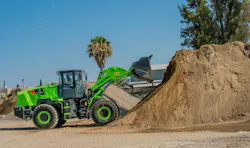
The LiuGong 856HE electric wheel loader proves electric isn’t a compromise. It’s an upgrade. Built for demanding environments like waste transfer and recycling, it eliminates diesel costs, emissions, and maintenance-heavy components. Powered by a 423-kWh battery, it delivers eight to 12 hours of runtime on a single two-hour charge, enough for a full shift with minimal downtime. Fewer moving parts translate into up to 40 percent lower total cost of ownership over the machine’s life. Inside, operators benefit from a quiet 59 dB cab, reducing fatigue and improving focus throughout the day. This is where sustainability meets profitability, without sacrificing performance. The 856HE sets a new benchmark for what heavy electric equipment should be. For more info, visit LiuGong’s website.
Genie S-85 XC FE hybrid boom lift
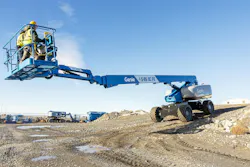
The Genie S-85 XC FE hybrid telescopic boom lift is engineered to deliver versatile rough-terrain performance, high capacity and electrified efficiency for demanding jobsite conditions and indoor operations. Designed with more than 80 quality improvements, the machine features right-sized 48-volt lithium-ion batteries, reduced maintenance requirements and AC E-Drive performance that delivers diesel-like power with lower emissions and less noise. The dual capacity capabilities of XC mean operators can lift up to 1,000 pounds for the majority of the lift’s range, and 660 pounds through the full envelope. With Genie’s patented Lift Power system, operators can charge and run power tools at height, including heavy-duty welders. The S-85 XC FE can be equipped with Genie’s new Lift Guard Lanyard Alert system, which provides visual and audible alerts when a lanyard is not attached to the designated anchor point. The Advanced version prevents boom functions until proper connection is confirmed. For more info, visit Genie’s website.
Skyjack SJ45 AJN and SJ45 ARJN slab booms
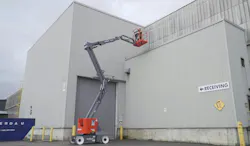
Skyjack recently announced the launch of its new SJ45 AJN and SJ45 ARJN battery-powered electric slab booms. Featuring a working height starting at 50 feet, 11 inches, Skyjack’s compact, zero-emission, low-noise SJ45 AJN and SJ45 ARJN have been designed to offer superior performance across indoor and outdoor jobsites. With a platform capacity of 500 pounds, a 4-foot, 8-inch jib as standard, and a narrow width of 4 feet, 11 inches, the SJ45 AJN provides class-leading up-and-over access capability of 25 feet, 7 inches. These booms feature Easydrive, an intuitive direction sensing function that allows the machine to move in the general direction of the joystick’s movement, where forward is forward and backward is backward. There is no need to coordinate colored directional arrows on the base of the machine. These booms also feature Skyriser technology, which ensures that the riser and main pivot point connecting the fly boom to the riser travel in a straight vertical line. Movement in a true vertical manner, without drifting forward or back, reduces the amount of repositioning the operator needs to do in order to stay close to a building facade, improving productivity. For more info, visit Skyjack’s website.
Toro eDingo TX 750
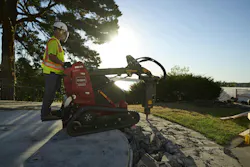
Building on the success of Toro’s eDingo 500, the new eDingo TX 750 combines the versatility and maneuverability of Toro’s trusted Dingo line with advanced electric power, meeting the growing demand for reliable battery-powered solutions in the compact utility loader market. Powered by Toro’s proprietary HyperCell Battery System, this machine delivers up to eight hours of runtime, guaranteeing maximum productivity for crews pushing through long, demanding shifts. Available in both narrow-track and wide-track models, the eDingo TX 750 is a versatile, durable, and high-demand piece of equipment. From interior construction and demolition to outdoor landscaping and debris clearing, this innovative machine is built to tackle demanding tasks with ease, optimize productivity, and deliver superior efficiency and all-day reliability. The rugged build and compact design of the new eDingo TX 750 make it a standout choice for demanding environments, while its electric operation lowers maintenance needs and eliminates downtime. For more info, visit Toro's website.
Case TL100EV mini track loader
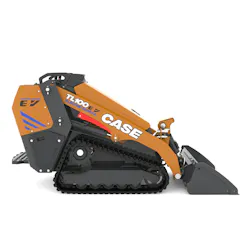
The new Case Construction Equipment TL100EV electric mini track loader is a compact, stand-on machine purpose-built for low-noise, zero-emissions jobsites such as indoor demolition, schools, and hospitals. With a 1,000-pound rated operating capacity, it combines the capabilities of a loader, lifter, and multi-purpose attachment carrier. Powered by a 25-kWh battery and three electric motors, it delivers strong torque and performance comparable to a diesel machine. Compatible with more than 40 industry-standard attachments, the TL100EV offers multiple track options, including a non-marring track for indoor or finished surfaces. The radial linkage loader arm improves digging performance while a 7 ft. 2 in. hinge pin height gives plenty of clearance for loading trailers and dumpsters. Operators benefit from customizable electro-hydraulic controls, enhanced lighting features, and multiple work modes. Charging is handled via an onboard J1772 Type 1 automotive-style charger, with an optional offboard DC fast charger available. The TL100EV comes with Case’s two-year/2,000 hours base vehicle warranty and 3-year/3,000 hours battery/EV component warranty. For more info, visit Case’s website.
Takeuchi TB20e compact excavator
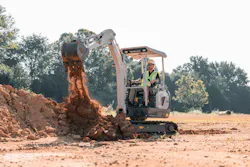
Takeuchi’s TB20e battery-powered compact excavator features a retractable undercarriage, enabling it to pass between structures or through openings as narrow as 38.6 inches, like gates and doorways. The TB20e comes standard with outstanding operator comfort, easy daily maintenance points and an on-board charger for simple recharging after the workday. On a full charge, the TB20e will run for approximately eight hours at 65 percent load. Going fully electric with the TB20e can decrease downtime by delaying routine maintenance and reducing overall operating costs. The TB20e has an operating weight of 4,255 pounds, and a primary auxiliary flow of 9 gallons per minute. Maximum reach is 13 feet, 4.9 inches and maximum digging depth is 7 feet, 10 inches. The TB20e is an environmentally friendly, sustainable choice when working in or around residential neighborhoods, hospitals and schools, thanks to its zero exhaust emissions and reduced noise/vibration levels. For more info, visit Takeuchi’s website.
JCB 19C-1E mini excavator
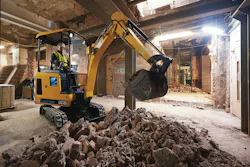
The JCB 19C-1E electric mini excavator delivers zero-emission performance without sacrificing capability. Built as a dedicated electric platform, it matches the performance of diesel counterparts with no tailpipe emissions. Powered by a 48V lithium-ion battery, it supports a full shift in typical applications and can be recharged using a standard 110V supply or JCB’s Universal Fast Charger. With a transport weight of 4,027 pounds and an operating weight of 4,193 pounds, the 19C-1E is built for easy towing and confined jobsite access. Maximum digging depth is 8 feet, 5 inches, and compact dimensions make it well suited for confined urban projects, including use inside buildings and in environmentally sensitive areas. With no engine oil, fuel filters, or exhaust aftertreatment systems, service requirements are reduced compared to diesel machines. For more info, visit JCB’s website.
Bobcat E19e compact excavator
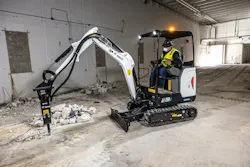
Electric compact equipment continues to gain momentum across indoor, urban and noise-sensitive jobsites as contractors and municipalities turn to battery-powered solutions to meet evolving sustainability demands. Valued for their versatility and ability to perform in confined spaces, compact excavators play a key role on modern jobsites. The Bobcat E19e battery-electric compact excavator reflects this shift, delivering the performance operators expect while offering zero-emission operation suited for environmentally sensitive applications. Its compact design and retractable undercarriage support efficient access through tight entryways and confined work areas. Powered by advanced lithium-ion battery technology, the E19e delivers equal to or greater performance than its diesel counterpart, with consistent hydraulic power and smooth, precise control. Efficient electric power helps support lower operating costs, while a simplified system with fewer parts and fluids reduces maintenance demands. The E19e features 17.3 kWh capacity, a maximum dig depth of 101 inches, reach of 165.9 inches and an operating weight of 4,212 pounds in the 2-ton class. For more info, visit Bobcat’s website.
New Holland C314X mini track loader and E25X mini excavator

The New Holland C314X and E25X represent the next generation of compact construction equipment, delivering electric performance without compromising capability. The C314X Electric Mini Track Loader brings zero‑emission, low‑noise operation to tight and sensitive jobsites, making it ideal for landscaping, material handling, and indoor or residential work. Powered by a lithium‑ion battery, the C314X offers instant hydraulic response, reduced maintenance, and the versatility to run a wide range of attachments—without exhaust fumes or excessive noise. Paired with it, the E25X Electric Mini Excavator provides contractors with a 2.5‑ton solution designed for precision digging in confined spaces. With up to an 8‑foot dig depth, multiple operating modes, and quiet electric operation, the E25X is well-suited for utility installation, plumbing, interior construction, and demolition in noise‑restricted areas. Together, the C314X and E25X expand jobsite flexibility while supporting a cleaner, more efficient way to work. For more information, please visit New Holland's website.
JLG micro scissor lifts
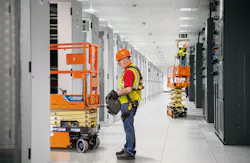
The JLG micro-sized scissor lift family introduces compact, lightweight, electric-powered machines designed for confined and sensitive jobsites such as hospitals, schools, data centers, and commercial facilities. The lineup includes the ES1330M, ES1530M, ES1930M, and ES2632M, all engineered for superior maneuverability with narrow widths, zero turning radius, and low machine weights that allow use on delicate flooring and in freight elevators. These lifts prioritize operator productivity and confidence with stable platforms, capacities up to 600 pounds and features like QuikFold rails for easy access through tight spaces. The ES2632M expands the range with a higher working height while maintaining compactness. Advanced technologies such as ClearSky Smart Fleet IoT, variable tilt, and Progressive Elevated Drive improve efficiency, diagnostics, and control. Overall, the range delivers strong performance, versatility and reduced total cost of ownership in space-constrained environments. For more info, visit JLG's website.
Vanair EPEQ ecosystem
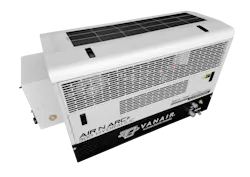
Vanair introduced five new products at Work Truck Week 2026 that expand its EPEQ Electrified Power Equipment ecosystem, addressing fleet demands for practical idle reduction solutions that extend vehicle service life and reduce maintenance costs. The EPEQ Power Center serves as a self-contained 48-volt power hub consolidating batteries, inverters and charging into a single enclosure that integrates with EPEQ compressors, hydraulics and welders. The new 12-volt battery and inverter line extends EPEQ technology to lighter-duty vans and delivery vehicles, pairing 100 Ah and 200 Ah lithium iron phosphate batteries with pure sine wave inverters up to 3,000W to prevent auxiliary loads from depleting starting batteries. EPEQ Solar Assist uses patented flexible solar panels with more than 2,100 conductive pathways to maintain battery charge in shaded conditions. The system arrives factory-installed on Vanair equipment, eliminating upfitter labor costs. Vanair also demonstrated a chassis-mount Velion 50kW DC fast charger paired with an Xcite PTO-driven generator for mobile EV charging, and upgraded 48-volt batteries with IP67 dust and water protection. For more info, visit Vanair’s website.
VMAC’s E30 mobile compressor with Stealth Power
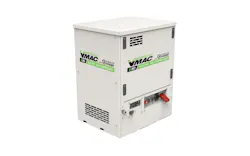
VMAC’s E30 with Stealth Power represents a significant achievement in battery-powered mobile compressed air, designed for electric and hybrid service trucks and vans. Engineered and manufactured in North America, the E30 delivers continuous 30 CFM at 100 psi, with a maximum of 150 psi, using VMAC’s patented rotary screw technology for 100% duty cycle performance. What sets the E30 apart is its combination of compact design, lightweight construction, and advanced battery integration. Weighing just 395 pounds, it is designed to preserve space and reduce weight on modern service vehicles. The optional Data Collection Module (DCM) provides real-time performance data over Cellular Network or Bluetooth. Operators can monitor runtime, energy consumption, and system health, while fleet managers gain remote access to metrics and customizable alerts such as low energy levels, temperature risk, and component wear. Stealth Powers’ advanced NMC battery technology delivers 15 percent more run-time per charge compared to competitors’ systems. With zero emissions, integrated batteries, quiet operation, and optional DCM, the E30 for fleets prioritizing sustainability, efficiency, and uptime. For more info, visit VMAC's website.
About the Author
Keith Gribbins
Keith Gribbins is the head of content at Construction Equipment, where he leads editorial strategy across print, digital, video, and social channels. An award-winning journalist with more than 20 years of experience, Keith has won 17 national and regional editorial awards and is known for his hands-on reporting style, regularly visiting manufacturers, operating equipment, and covering major industry events worldwide.