Need a Drone Survey? SPH Engineering Just Opened Up a Marketplace for Specialized UAV Services
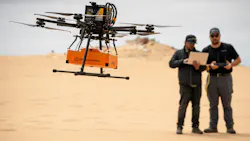
Key takeaways:
- SPH Engineering launched a global drone marketplace connecting project owners with specialized UAV service providers in more than 38 countries.
- The platform focuses on advanced drone applications such as LiDAR mapping, ground-penetrating radar, bathymetric surveys, and photogrammetry.
- Construction, mining, and utility firms can access specialized drone expertise without investing in expensive equipment or building in-house drone programs.
Drone technology still sounds a little futuristic for old school construction pros. What do they do exactly on a worksite? Take photos and videos? Well, yes, but so much more. Drones can help construction firms perform utility mapping. They are used by mining companies to conduct volumetric surveys. Utility operations use them to find methane leaks. When you actually realize all the cool stuff drones can do, you wonder why they’re not being used more.
I guess the main reason is many construction fleets have never really embraced the specialized nature of drones, their technology, and their operation. They can still feel foreign to many fleet managers. Well, a company known for advanced drone surveying software wants to change that. Latvia-based SPH Engineering recently launched its new Marketplace, a global online platform designed to connect folks who need drones (project owners, engineers, contractors, and researchers) with local specialized drone service providers who can even perform the work. The new network launches with more than 100 partners across 38 countries. From this press release:
"We built this platform to solve a very concrete industry problem," said Alexey Dobrovolskiy, CEO at SPH Engineering. "Project managers and researchers know exactly what surveying data they need, but locating a reliable local drone team with the right payload can stall a project for weeks. At the same time, highly skilled operators often have expensive equipment sitting idle. The Marketplace bridges that gap, creating a trusted environment where demand meets capability without the heavy capital expenditure."
What the SPH Engineering Marketplace does

Drone technology has matured, while access has not. SPH Engineering built its Marketplace to help. Users submit a project request through the platform. The system then routes the request to qualified partners with the cool equipment and expertise. The Marketplace covers Europe, North America, Latin America, Asia-Pacific, and Africa, with additional partners being teased.
“The U.S. and Canada currently account for approximately one-third of our total global partner network,” said Dobrovolskiy via email. “Out of our 100+ partners globally, around 30 are based in North America.”
What’s also impressive is that this platform focuses on specialized drone services. These include the use of high-tech sensors — the orange boxes or weird poles you see hanging from the drones in photos. Here's a drone with a magnetometer, for instance. These can be heavy and awkward payloads — a challenge for organizations to master internally. But if you can find the right subcontractor, there are a lot of useful applications. In fact, here are some examples of sci-fi-sounding drone jobs in construction, mining, and beyond.
Drone application examples
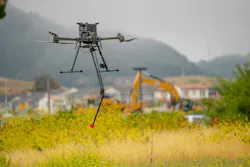
- Drone-mounted LiDAR systems: Applications might include measuring stockpile volumes at a quarry or aggregate yard or creating a digital terrain model for a large site-development project.
- Ground-penetrating radar (GPR): Jobs might include locating buried gas lines before excavation begins or detecting voids beneath a roadway or parking lot.
- Magnetometers: Crews could use these to find unexploded ordnance (UXO) before earthmoving operations or locate abandoned oil and gas wellheads on a construction site.
- Echo sounders for bathymetry: Applications might include measuring sediment buildup in a stormwater retention pond or surveying a tailings pond at a mining operation.
- Methane detection sensors: These could be used to inspect natural gas pipelines for leaks or monitor methane emissions at a landfill.
- Gamma-ray spectrometers: Applications might include mapping mineral-rich terrain before drilling or conducting environmental radiation surveys around an industrial site.
- Photogrammetry systems: Applications might include generating orthomosaic maps of a construction site or calculating cut-and-fill volumes during earthmoving.
- There are lot of other cool drone technologies you can learn about over at SPH Engineering’s website.
A company built around industrial drone applications
SPH Engineering is not a drone manufacturer. The company develops software, sensor integrations, and data collection systems that allow commercial drones to perform complex tasks. Founded in Latvia in 2013, SPH Engineering grew from a startup focused on drone flight planning software into a global drone technology provider with customers and partners in more than 150 countries. Its flagship product, UgCS, became one of the industry’s leading flight-planning platforms. The software allows operators to create complex automated missions, including terrain-following flights, LiDAR surveys, and large-area mapping projects. Today, SPH Engineering services a variety of sectors — construction, mining, oil and gas, academic research, and even entertainment.
A growing ecosystem for industrial drone work
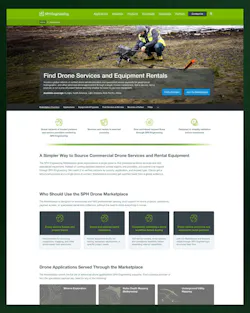
SPH Engineering's new Marketplace focuses on fleet masters and project owners who need to source experienced drone operators with advanced sensors and data collection services through a single network. As drone tech becomes more sophisticated, platforms like this could play an increasingly important role in bringing advanced aerial data collection into everyday operations. Check out SPH’s Marketplace. Then cue this song.
About the Author
Keith Gribbins
Keith Gribbins is the head of content at Construction Equipment, where he leads editorial strategy across print, digital, video, and social channels. An award-winning journalist with more than 20 years of experience, Keith has won 17 national and regional editorial awards and is known for his hands-on reporting style, regularly visiting manufacturers, operating equipment, and covering major industry events worldwide.